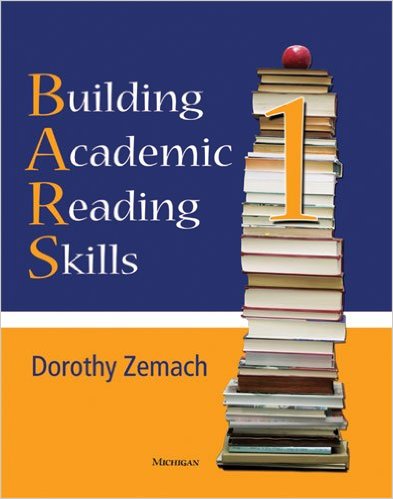
| Building Academic Reading Skills, Book 1
Dorothy Zemach 2009 ISBN-13: 978-0-472-03369-0 US $27.95 (paperback) 118 pp. The University of Michigan Press Ann Arbor, MI |
|
- Descriptive Summary
Academic reading is a challenge for ESL/EFL learners. However, even for native speakers of English, academic reading skills require deliberate instruction and diligent practice. Because academic reading is often regarded as the foundation of college and university study, the acquisition of academic reading skills is in great demand. The target audience of Building Academic Reading Skills is intermediate to high-intermediate college and university students who need to deal with various types of texts, considerable amounts of reading, and multi-subject content.
The objectives of the textbook are stated as follows. First, students will be able to use context clues to cope with the vocabulary they will encounter in academic reading, thus enabling them to comprehend the article without looking every word up in a dictionary. Second, students will be able to apply skimming and scanning skills to moderately long reading in order to develop an understanding of the overall structure of the article. Third, students will be able to apply the information learned from the textbook more broadly to other areas through practice and discussion.
The texts in the textbook come from multiple sources, including blog posts, online journals, newspapers, and magazine articles. The author integrates the content with diverse types and genres of readings in order to cater to different students.
Each of the textbook’s six units focus on one high-interest topic, incorporating two different academic disciplines with two types of the abovementioned readings (Unit 1: cross-cultural communication and environmental science; Unit 2: chemistry and cultural anthropology; Unit 3: biology and art; Unit 4: geology and political science; Unit 5: mathematics and psychology; Unit 6: history and creative writing). The textbook’s pre-reading, during reading, and post-reading development activities assist students with their reading comprehension through both top-down and bottom-up processes. Vandergrift (2004) suggested that students use top-down process when context or prior knowledge is employed for comprehension, and students use bottom-up process when they identify vocabulary and combine units to make texts meaningful. The author includes prediction activities (see Figure 1) to guide students to connect the title of each article to their prior knowledge and experiences, providing top-down scaffolding. The book offers some vocabulary activities (see Figure 2) to help students successfully “notice” target vocabulary, which is one of the three psychological processes for successful vocabulary learning (Nation, 2001).
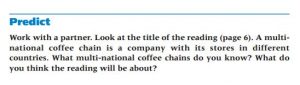
Figure 1. An example of prediction and discussion in Unit 1
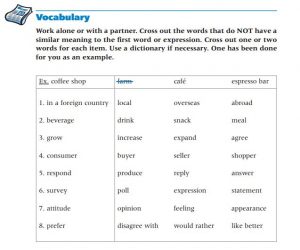
FIGURE 2. An Example of vocabulary activity in Unit 1
Each unit introduces one or two reading strategies to students in order to help them better understand the readings. As shown in Table 1, reading strategies are introduced with each reading. The book provides various practices to reinforce these reading strategies. An example is provided in Figure 3.
| Table 1
Reading Strategies Overview |
||
| Purposes (SWBAT) | Unit & Reading | Reading Strategies |
| Be aware of the structure of an article | Unit 1 reading 1 | Skimming and scanning skill |
| Unit 1 reading 2 | Identify words and phrases for transition | |
| Identify the main idea of an article | Unit 2 reading 1 | Identifying the signpost words in titles and texts |
| Unit 5 reading 1 | Tips about drawing conclusion | |
| Figure out the meaning of new vocabulary without the help of the dictionary | Unit 2 reading 2 | Use the context to deal with new words |
| Unit 3 reading 2 | Use the contrast clues to deal with new words | |
| Successfully distinguish the differences of some ambiguous terms during reading | Unit 3 reading 1 | Identify definitions, explanations, and examples |
| Unit 4 reading 2 | Identify facts and opinions | |
| Unit 6 reading 2 | Distinguish facts from humor and exaggerations | |
| Have a better understanding of intentions of writers/ follow their ideas smoothly and easily | Unit 4 reading 1 | Locate pronoun referents |
| Unit 5 reading 2 | Comprehend the inferences of the writer | |
| Table 1 | ||
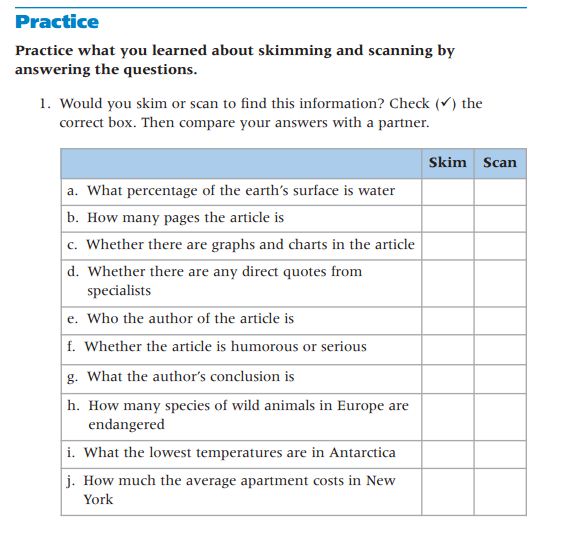
FIGURE 3. A Reading Strategy Practice
- Evaluative Summary
This textbook sets a good example of teaching language through academic study. The author provides a lot of scaffolding before the reading, which is mainly about content and vocabulary. Krashen (1982) argued for the importance of scaffolding when he wrote that language acquisition occurs when students receive enough comprehensible input. The correlation between student academic reading comprehension and their vocabulary knowledge has been confirmed by several researchers (Alderson, 2000; Anderson & Freebody, 1981; Mezynski, 1983; Read, 2000). Students will acquire strategies from the textbook to be able to deal with common academic vocabulary in their study.
The textbook is useful for students because they can acquire reading strategies by repeatedly practicing within the subsequent units, thus enabling them to apply the strategies to cope with progressively advanced academic texts. Because of the arrangement pattern, the teachers who use the textbook are strongly encouraged to do every unit in order. In this way students are likely to be amazed by their progress and their ability to successfully handle more difficult readings.
I find this textbook generally falls in line with Erlam’s (2016) idea of task-based language teaching (TBLT). She proposed (p.280) that a task should fulfill these following four criteria: Its primarily focus will be on ‘meaning’ rather than on ‘linguistic form’; it enables students to use their own both linguistic and non-linguistic resources to complete it; a gap in some way is required so that students need to exchange their information to complete the task; it has a clear outcome.
This is a practical textbook, because the author does not just aim at checking students’ comprehension of the texts, she also requires students to apply both their prior language knowledge and what they have learned before to broader practical uses. The practice prompts students to perform in life-like communicative ways rather than in highly-synthetic and modified classroom contexts. The extension activity for each reading helps students to reflect on the reading and leads them to extend their learning into a related discussion. For example, Unit 1 is about coffee. The article is about attitudes toward multi-national coffee chains. In the extension activity, students are asked to imagine themselves working in the marketing department of a large multi-national coffee chain and to evaluate some information mentioned in the article they just read. Another example is Unit 2. Love is the topic of this unit, and the article is about chemistry. The reading introduces how some chemicals related to love affect the body in different ways. In the extension activity students can do a role playing activity. Student can be a marriage counselor, who is asked to give advice to a husband. Clearly the main focus of the activity falls on conveying meanings rather than the form (criterion 1). What’s more, the knowledge required for the task is not restricted to what can be learned from the textbook, students need to “rely on their own resources” to perform the activity (criterion 2). In addition, there will be an outcome when students reach an agreement after discussion (criterion 4). However, a problem existing in those activities in the extension is that there seems a gap between the knowledge that students already have and the knowledge that requires for completing the task.
If a teacher wants to implement the book within a more task-based language teaching class, something more should be done. For unit 1, the teacher can design a writing task. The teacher can have students take their grandparents or older friends to have a cup of coffee at Starbucks, and ask their opinions of coffee and Starbucks. Students will be required to translate their opinions in English and write them down, and the writing part will be graded. The students can be provided feedback from other students and the teacher. As for Unit 2, in which students learn and discuss issues surrounding dating, the teacher can first ask the students to define what love is, and then students will be required to do a survey (Appendix 1) before they partake in an activity on marriage counselors from the textbook. After the survey, the students might be better understanding of the problem of the husband in the activity (he is disaffected by love), and they can offer more concrete advice based on their own interpretation of love. This activity can be designed as a speaking task. Students can be grouped in pairs and act out their conversation.
To sum, generally the textbook is quite useful for academic-reading-skills building. Although there are a lot of textbooks available for academic readings, few of them focus both on academic study preparation and practical communicative language learning. Even though some scaffolding might be needed for this textbook to make it better in relation to task-based language teaching, it does provide a foundation for a communicative teaching class.
References
Alderson, J. C. (2000). Assessing reading. Cambridge language assessment series. New York, NY: Cambridge University Press
Anderson, R. C. & Freebody. P. (1981). Vocabulary knowledge. In J. T. Guthrie (Ed.), Comprehension and teaching: Research reviews, (pp. 77-117). Retrieved from http://files.eric.ed.gov/fulltext/ED203299.pdf
Erlam, R. (2016). ‘I’m still not sure what a task is’: Teachers designing language tasks. Language Teaching Research, 20(3), 279-299.
Krashen, S. (1982). Principles and practice in second language acquisition. Oxford: Pergamon Press. Retrieved from http://www.sdkrashen.com/content/books/principles_and_practice.pdf
Mezynski, K. (1983). Issues concerning the acquisition of knowledge: Effects of vocabulary training on reading comprehension. Review of Educational Research, 53(2), 253-279.
Nation, I. S. (2001). Learning vocabulary in another language. Cambridge, UK: Cambridge University Press.
Read, J. (2000). Assessing vocabulary. New York, NY: Cambridge University Press.
Vandergrift, L. (2004). Listening to leearn or learning to listen? Annual Review of Applied Linguistics, 24, 3-25.
Appendix 1
| A man loves his wife if… | Not at all true | A little true | Moderately true | Mostly true | Definitely true |
| 1. He knows her birthday, all the anniversaries, and important holidays, and he will send a gift to her. | |||||
| 2. He is always honest to her. | |||||
| 3. He allows her to watch his cell phone. | |||||
| 3. He cannot feel anything when he saw a hot woman. | |||||
| 4. He introduces her to all his friends. | |||||
| 5. He knows how to keep proper distance from other women. | |||||
| 6. He is willing to pay for something she wants. | |||||
| 7. He asks her if she is happy or tired. | |||||
| 8. He is willing to spare time for her when he is busy. | |||||
| 9. He responds to her phone calls and text messages as soon as possible. | |||||
| 10. He feels jealous and angry when he saw her with another man. | |||||
| 11. He always says “sorry” first after they have a conflict. | |||||
| 12. He is patient when they go shopping together. |